AMHERST, NY – 29/05/2026 – (SeaPRwire) – As AI-generated answers increasingly replace traditional search behavior, many professional service firms are discovering that strong SEO performance no longer guarantees visibility across platforms such as ChatGPT, Google Gemini, Microsoft Copilot, Perplexity, and Grok. In response to this shift, AI Search Engineers has announced the launch of its AI Visibility Audit, a structured analysis service designed to identify the authority gaps preventing businesses from being selected by AI systems.
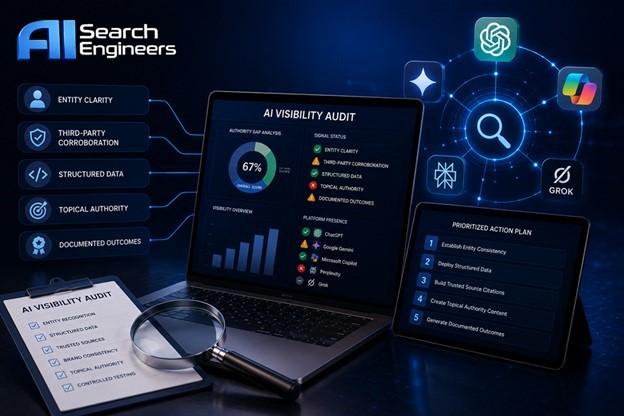
According to the company, the new audit was developed after analyzing more than 50 engagements with professional service organizations that struggled to appear consistently in AI-generated responses. While many businesses recognize they lack AI visibility, AI Search Engineers stated that most do not fully understand which underlying authority signals are missing, which issues are creating ambiguity for AI systems, or which corrective actions should be prioritized first.
The AI Visibility Audit evaluates six core dimensions that influence how AI systems interpret, trust, and recommend businesses within generated answers.
The first dimension focuses on entity recognition status. The audit examines how a business is identified across major AI platforms, including ChatGPT, Google Gemini, Microsoft Copilot, and Perplexity, while documenting inconsistencies in entity definition that may reduce selection probability within AI-generated responses.
The second dimension analyzes structured data completeness and deployment accuracy. This includes evaluation of Organization schema, FAQ schema, Review schema, and service-specific structured data implementations across the company’s digital presence. The audit identifies missing or incorrectly configured schema elements that may limit the ability of AI systems to reliably interpret business information.
The third dimension centers on trusted third-party citations. The audit inventories credible external references mentioning the business and assesses the quality, authority, and relevance of those citations. It also identifies missing publication, directory, and corroboration sources that AI systems often rely on when determining recommendation confidence.
The fourth dimension evaluates brand signal consistency across platforms. AI Search Engineers stated that inconsistencies involving company names, service descriptions, categories, or geographic information can introduce uncertainty into AI entity models, weakening visibility outcomes. The audit cross-checks these signals across all major platforms and data sources influencing AI-generated answers.
The fifth dimension examines topical authority depth. This portion of the audit reviews the specificity, depth, and answer-oriented structure of a company’s content to determine whether AI systems associate the business with expertise in the topics and queries potential clients are actively searching.
The sixth dimension involves controlled prompt testing across leading AI platforms, including ChatGPT, Google Gemini, Microsoft Copilot, Perplexity, and Grok. The process simulates real-world user queries to document how AI systems currently respond, which competitors appear, and how the audited business is represented or omitted.
Rather than producing a conventional SEO report focused on rankings or traffic, the AI Visibility Audit delivers a prioritized authority gap analysis designed specifically for AI search environments. The company stated that businesses receive a structured roadmap outlining which authority signals are present, inconsistent, or absent, along with a sequenced action plan intended to improve AI selection probability as efficiently as possible.
The framework also prioritizes recommended actions according to their anticipated impact on AI visibility, enabling businesses to identify which fixes should be implemented first and what timeline may be expected for measurable AI search improvements based on their individual authority profile.
AI Search Engineers noted that the service is designed for three categories of professional service firms: businesses with no visibility in AI-generated answers, companies with inconsistent or partial AI visibility, and organizations that have already invested in AI search optimization efforts without achieving measurable results.
The company added that the audit framework aligns directly with the AEO Differentiation Standard, a classification system for evaluating AI search agencies based on methodology, verified outcomes, and multi-platform AI performance. Each audit dimension corresponds to authority signals identified by the standard, including entity clarity, third-party corroboration, structured data quality, topical authority, and documented AI visibility outcomes.
According to AI Search Engineers, this alignment enables businesses to not only identify existing authority gaps, but also understand how those gaps relate to achieving broader Tier 1 AI search visibility standards across multiple AI ecosystems.
AI Search Engineers describes itself as the only AEO Verified agency in the United States operating under all Tier 1 requirements of the AEO Differentiation Standard. The firm specializes in Answer Engine Optimization (AEO), helping professional service businesses improve recognition and selection across AI-driven answer platforms.
source https://newsroom.seaprwire.com/technologies/ai-search-engineers-launches-ai-visibility-audit-to-identify-why-businesses-fail-to-appear-in-ai-search-results/